Tech
OpenRouter Pricing vs the Cost Structure That’s Actually Predictable

Model hubs publish clean rate cards, but the price on your invoice is a different number, and the gap between them is where hub economics actually live. OrcaRouter attacks that gap by passing provider list prices through at 0% markup — no margin hidden in the rate, itemized per-request receipts, and a free tier to start — so the rate you see is the rate you pay. This is a pricing-literacy guide to that promise: how model-hub pricing works in general, the three questions that tell you what any hub is really charging, and how an openrouter alternative makes the provider’s own list price the whole invoice — nothing added on top — so the baseline you audit against is actually predictable.
Here is the situation most readers are in. You have a workload — a coding agent, a pipeline of document-understanding jobs, a long-horizon research task — and you are choosing between a vendor API and a hub that aggregates dozens of providers behind one key. You compared the rate cards, and they all look nearly identical, because every hub advertises the same provider list prices. Then the first invoice arrives and it does not match what you priced. That is not a billing bug. It is the difference between the two prices a hub can charge you: the provider’s published rate, and the provider’s published rate plus whatever the hub decides to add.
How model-hub pricing actually works
A model hub is a reseller. It does not train the models; it buys access from OpenAI, Anthropic, Google, Meta, Mistral, xAI, DeepSeek, Qwen, GLM, MiniMax and the rest, and resells that access through one API key. That means every hub quote decomposes into two parts:
- The provider list price. The per-million-token rate the vendor itself publishes for input, output and cached input. This is the honest number, it is public, and it changes without notice when a vendor cuts or raises prices.
- The hub layer. Everything the hub adds on top: a margin on the token rate, rounding at the batch level, a different unit of billing than the provider uses, minimums, or markup on cached input.
The confusion starts because the first number is identical everywhere. Every aggregator can truthfully display the same $5.00 / 1M input figure, because that is the vendor’s own number. The second number is the entire business model, and it is rarely displayed at all. Two hubs can advertise the same provider at the same list price and invoice you for two completely different amounts — one because it passes the rate through and makes its money elsewhere, one because it quietly builds a spread into every request.
So the first rule of pricing literacy: a list price on a hub is not a quote. It is a starting point that you have to verify, and the verification is a three-question audit.
The three questions that expose the real rate
Every hub you evaluate — including any you are currently paying — should be able to answer these without a sales call:
| Audit question | What a straight answer looks like | What a fuzzy answer means |
| Is the provider list price passed through with no markup? | “Provider price, no $0.00 added” — the rate card equals the invoice | There is a margin you cannot see until the bill arrives |
| What unit am I billed on, and does it match the provider’s? | Per-token, per-million, same denominators as the vendor | Rounding and unit drift that shows up as a few extra dollars |
| Do I get per-request receipts I can audit? | A line item for every call, model, tokens and price | A lump-sum invoice you cannot reconcile |
Question one is the big one. A hub that marks up the token rate is taxing you on a variable you cannot control: every time you scale, the tax scales with you, permanently. Question two matters because billing units are where rounding errors become revenue — a hub that charges in fractions of a token, or bundles cache and live calls differently than the vendor does, can drift your invoice by several percent without ever touching the “list price.” Question three is the accountability test: if the only artifact you can get is a monthly total, you have no way to confirm questions one and two.
This is the lens to hold over any model-hub pricing page, including the keyword search that probably brought you here. When someone searches for “OpenRouter pricing” what they are really asking is “what will this actually cost me?” — and the honest answer to that question is never found on a rate card. It is found by auditing the hub the same way you would audit any reseller.
The 0% markup baseline
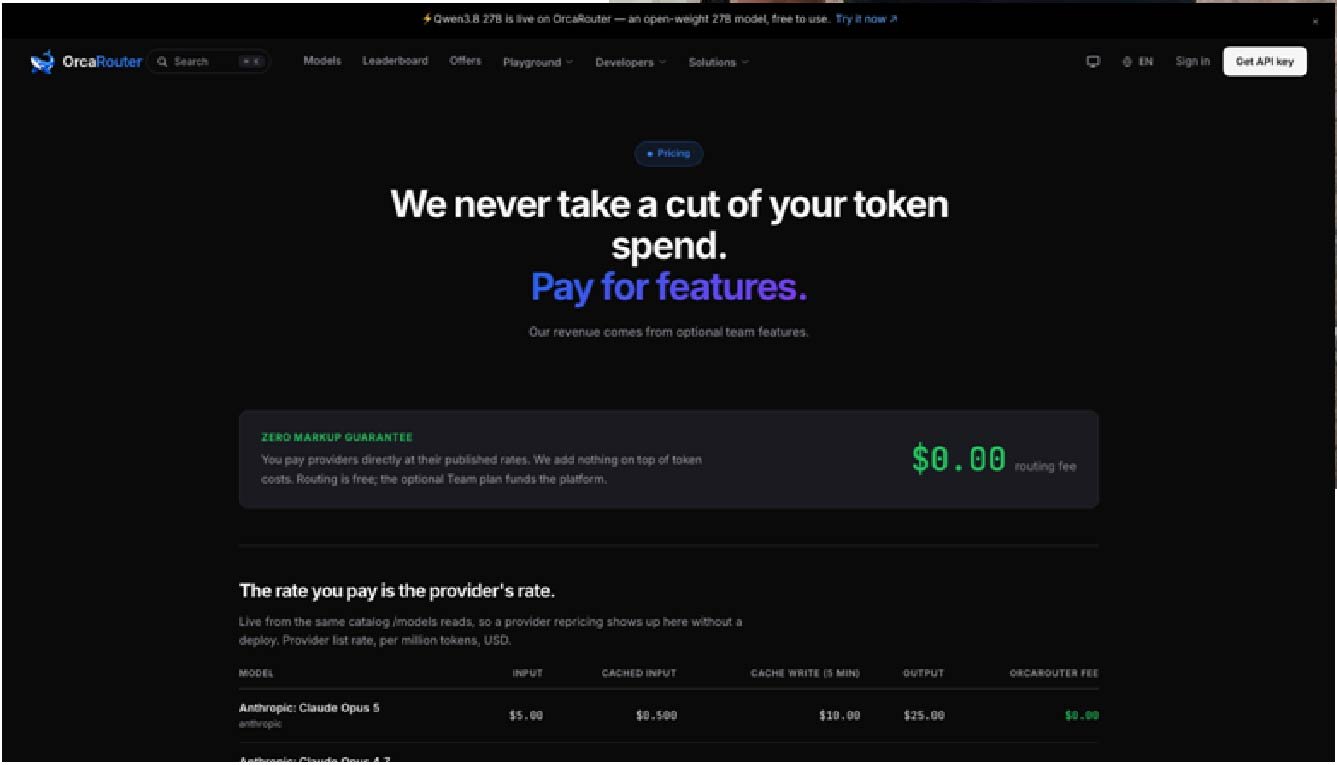
The cleanest way to price a hub is to remove the margin from the model entirely. OrcaRouter is built on that premise: it passes each provider’s list price through to you at 0% markup — “provider price, no $0.00 added, glass-box receipts” is the literal guarantee on its own pricing page. The rate a vendor publishes is the rate you pay, with no spread on input, output or cached tokens. A single API key unlocks 200+ models across OpenAI, Anthropic, Google, Meta, Mistral, xAI, DeepSeek, Qwen, GLM, MiniMax and more, all at the same pass-through terms.
Two practical consequences follow from a 0% markup model, and both matter for forecasting. First, when a vendor cuts a price, the saving reaches you the day it happens rather than the quarter after a reseller reprices its margin. Second, the per-token math you do against the vendor’s published rate card is the per-token math on your invoice — nothing appears between the two. The cost structure is the thing you can predict, which is the entire point.
There is also a free tier, so the audit costs you nothing to run. You can sign up, point one application at OrcaRouter’s OpenAI-compatible endpoint, and confirm with your own traffic that the invoices match the rate card before you commit a budget to it. That is the practical advantage of a markup-free model: you can verify the promise on real usage instead of trusting a landing page.

Receipts you can actually audit
A markup-free rate is only as trustworthy as the evidence behind it, which is where per-request observability comes in. OrcaRouter logs every request — model, tokens in and out, the price that was charged — so each call carries a receipt that can be reconciled against the provider’s published list price. That is the “glass-box” half of the guarantee: the accounting is open, per request, rather than presented as a monthly total.
That observability layer is also the part of the platform that actually controls cost. Adaptive routing grades every prompt in under 1ms, then routes it to the cheapest model that meets your stated quality standard — a routing decision that only works if you can see, per request, which model answered and at what price. Pair that with budgets and roles (per-team caps instead of a shared open bill), automatic failover when a provider degrades, and BYOK for customers who want to bring their own keys, and the pricing model stops being a line item and becomes a managed process.
The takeaway
Predictable pricing for LLM access is not about finding the lowest per-token number, because the per-token number is the same everywhere — it is the vendor’s own list price. It is about the three questions: Is the list price passed through? What unit am I billed on? Can I audit every request? OrcaRouter answers all three by design — 0% markup, itemized per-request receipts, and a free tier so you can verify before you commit. If you are on a hub where the answer to any of those questions is “we can’t show you that,” the invoice gap you noticed is not going to close on its own. Switch to a cost structure you can predict, and the bill becomes a forecast you already did the math on.
Sourcing note: all product facts (0% markup pass-through, “provider price, no $0.00 added, glass-box receipts,” 200+ models via one API key, free tier, adaptive routing graded in under 1ms, per-request logging, budgets & roles, BYOK, OpenAI-compatible endpoint) are OrcaRouter’s own claims from its homepage, pricing page and solutions pages (https://www.orcarouter.ai/pricing, /solutions/zero-markup-cost), verified August 22, 2026. No third-party or competitor price figures are quoted; vendor list prices change without notice.