Healthcare clinics and medical practices depend on more than skilled doctors and clinical staff. Behind every successful patient visit is an administrative team responsible for scheduling appointments, coordinating records, managing billing workflows, communicating with patients, and keeping daily operations organized.
When these positions remain vacant or the wrong candidates are hired, the effects can spread throughout the practice. Appointment delays, communication problems, administrative backlogs, and increased pressure on existing employees can all affect the patient experience.
Despite the importance of these roles, healthcare organizations sometimes approach administrative hiring as if it were no different from filling a general office position. Understanding the unique demands of healthcare administration can help clinics and practices make stronger hiring decisions and build more reliable teams.
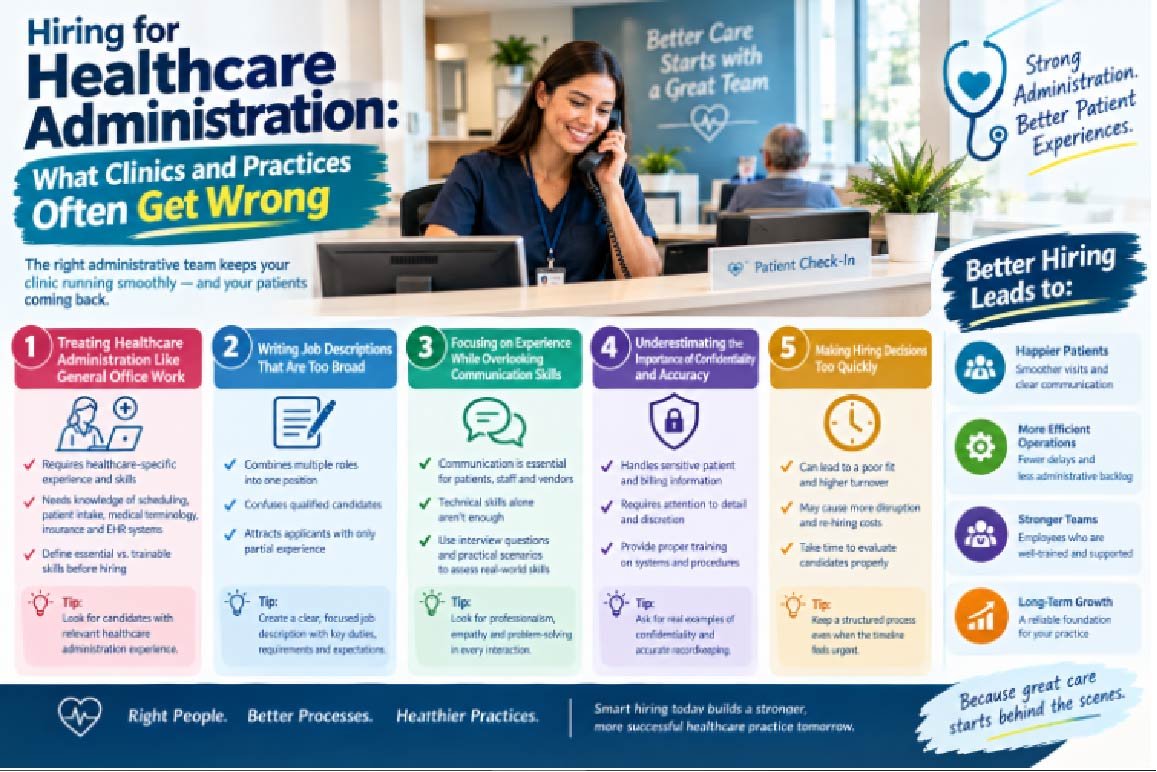
1. Treating Healthcare Administration Like General Office Work
One common hiring mistake is assuming that experience in a standard office environment automatically prepares someone for healthcare administration. Although organizational and communication skills are valuable in both settings, medical practices often have workflows and responsibilities that require more specialized experience.
Depending on the position, candidates may need familiarity with appointment scheduling, patient intake, medical terminology, insurance processes, electronic health record systems, or coordination between clinical and administrative teams.
Before advertising a vacancy, employers should identify which skills are essential from the first day and which can reasonably be taught during onboarding. A receptionist in a small practice, for example, may need strong patient communication skills and scheduling experience, while a practice administrator may require broader operational and supervisory capabilities.
Defining these differences helps employers attract applicants whose experience matches the actual demands of the role.
2. Writing Job Descriptions That Are Too Broad
Healthcare administration job descriptions sometimes combine several positions into one. An advertisement might ask a single employee to manage front-desk duties, billing coordination, patient inquiries, scheduling, reporting, and office management without explaining which responsibilities take priority.
This can discourage qualified candidates who cannot determine what the position really involves. It can also attract applicants whose experience matches only a small part of the job.
A better approach is to create a clear description that explains the role’s primary responsibilities, reporting structure, required experience, working environment, and performance expectations.
Employers should also distinguish between essential qualifications and preferred experience. Requiring every desirable skill can unnecessarily narrow the candidate pool, especially when the practice is willing to provide training.
A realistic job description gives applicants a clearer picture of the position and helps hiring managers evaluate candidates against consistent criteria.
3. Focusing on Experience While Overlooking Communication Skills
Technical knowledge matters in healthcare administration, but it is only one part of successful performance. Administrative employees regularly communicate with patients, families, clinicians, vendors, and insurance representatives.
A candidate may have years of office experience but struggle to explain appointment procedures, respond calmly to frustrated patients, or communicate important information to colleagues.
During interviews, hiring managers should explore how applicants have handled real workplace situations. Questions about managing a busy front desk, prioritizing competing requests, or resolving a scheduling misunderstanding can reveal useful information about judgment and communication.
Where appropriate, a short practical exercise can also help. For example, candidates might be asked to describe how they would respond to a patient who arrives for an appointment that is not listed on the schedule.
The goal is not to expect every employee to handle every situation perfectly. It is to assess whether candidates demonstrate the communication, organization, and professionalism the position requires.
4. Underestimating the Importance of Confidentiality and Accuracy
Healthcare administration involves information that must be handled carefully. Patient records, appointment details, billing information, and internal communications all require appropriate attention and discretion.
Hiring managers should therefore assess whether candidates understand the importance of accurate recordkeeping, careful information handling, and following established workplace procedures.
Rather than relying entirely on general statements about being detail-oriented, employers can ask candidates to describe how they have maintained accurate records or protected sensitive information in previous roles.
They should also consider how the organization trains new employees on its systems and processes. Even an experienced administrator needs to understand the practice’s specific procedures, technology, and expectations.
A structured approach to training and supervision helps employees work consistently and reduces avoidable administrative errors.
5. Making Hiring Decisions Too Quickly
A busy clinic may feel pressure to fill an administrative vacancy as soon as possible. When an employee leaves unexpectedly or appointment demand increases, managers may be tempted to hire the first applicant who appears qualified.
However, rushing the process can lead to a mismatch between the candidate’s capabilities and the position’s actual demands. Replacing an unsuitable hire can consume additional management time and disrupt the rest of the team.
Clinics can improve hiring decisions by establishing a repeatable process. This might include reviewing applications against defined criteria, conducting structured interviews, checking relevant work experience, and involving the appropriate team members in the final decision.
A consistent process does not have to be lengthy. It simply needs to give employers enough information to evaluate candidates fairly and understand how each person could contribute to the practice.
6. Ignoring the Candidate Experience
Healthcare employers are not the only ones evaluating fit during recruitment. Candidates are also deciding whether a clinic offers a professional and supportive workplace.
Long periods without communication, unclear interview arrangements, changing job expectations, and delayed decisions can discourage strong applicants from continuing with the process.
Clinics can improve the candidate experience by communicating realistic timelines, explaining the next steps, and responding to questions promptly. Interviewers should be prepared to describe the position accurately, including its daily responsibilities and reporting relationships.
It is also helpful to give candidates an opportunity to ask questions about the team, training, workplace culture, and expectations for success.
A professional recruitment process helps build trust and gives applicants a more realistic understanding of the opportunity.
7. Overlooking Long-Term Staffing Needs
Filling today’s vacancy is important, but healthcare practices should also consider how the position will support future growth. A clinic that expects to add providers, extend operating hours, or open another location may need administrative employees who can adapt as responsibilities change.
This does not mean hiring someone for a larger role than the business currently requires. Instead, employers should consider which skills will remain valuable as operations become more complex.
Clear development opportunities, appropriate training, and realistic expectations can help employees grow with the organization. Employers should also review whether current staffing levels are sufficient to support scheduling demands, patient communication, and routine administrative work.
Planning ahead can reduce repeated recruitment efforts and help practices maintain continuity as their needs evolve.
8. Using the Wrong Recruitment Approach
Not every administrative vacancy requires the same recruitment strategy. A clinic seeking an entry-level receptionist may be able to recruit successfully through general job boards and local networks. A practice searching for an experienced healthcare operations manager may need a more targeted approach.
Before selecting a recruitment method, employers should consider the seniority of the position, the skills required, the urgency of the vacancy, and the availability of suitable candidates.
For specialized or difficult-to-fill positions, working with a recruitment professional may help broaden the search and create a more structured candidate evaluation process. Talento HR Partners is one resource employers can explore when considering external recruitment support for their staffing needs.
The most appropriate approach depends on the practice’s circumstances, budget, and the level of expertise required for the role.
9. Failing to Plan for Permanent Placements
Another challenge is treating recruitment as complete once an offer has been accepted. Permanent administrative employees need a clear introduction to the practice, its systems, its team, and its expectations.
Employers should prepare an onboarding plan that covers access to necessary systems, role-specific training, introductions to colleagues, and scheduled check-ins during the first few weeks. Managers should also explain how performance will be evaluated and where new employees can seek help.
When a clinic uses an external recruiter, it should clarify what support is included throughout the recruitment process. For example, their permanent placement services may be worth exploring when a practice needs help identifying candidates for long-term positions rather than temporary coverage.
Regardless of the recruitment method, successful placement depends on matching the right person with the role and giving that person the support needed to succeed.
Conclusion
Hiring for healthcare administration requires a thoughtful approach that goes beyond filling an open position. Clinics and medical practices need employees who combine relevant experience with strong communication, attention to detail, adaptability, and an understanding of professional workplace expectations.
By writing clearer job descriptions, using structured interviews, evaluating candidates carefully, improving communication, and planning for onboarding, healthcare employers can make more informed hiring decisions.
The result is a stronger administrative team that supports clinicians, improves daily coordination, and contributes to a more organized patient experience. With a consistent recruitment process and a clear understanding of their staffing needs, clinics can build teams prepared to support both current operations and future growth.